Quiet Authority: How Halston's Philosophy of Restraint Rescued Prestige Television from Costume Drama Excess
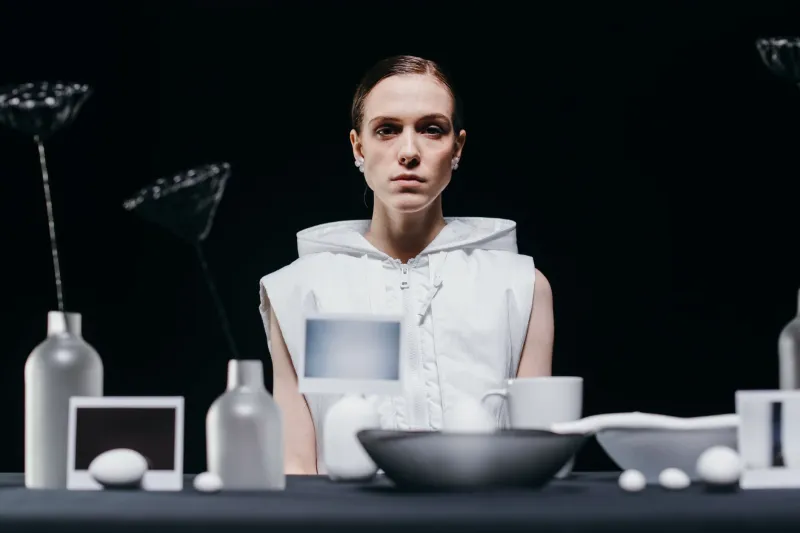
There is a particular trap that awaits every costume designer assigned to a prestige production: the temptation to overwhelm. Period dramas invite embroidery. Corporate thrillers invite tailoring so severe it borders on caricature. And biographical films — those portraits of real, complicated human beings — invite the kind of costuming that announces its own importance before the actor has spoken a single line. For decades, that trap swallowed entire productions whole, burying performance beneath brocade and character beneath conspicuous detail.
Then, quietly, something shifted. The designers who began resisting that pull did not always cite the same source of inspiration. But when their choices are laid side by side — the unbroken lines, the deliberate suppression of ornament, the insistence that fabric should serve the body rather than compete with it — a single aesthetic lineage becomes unmistakable. Halston's shadow, long and elegant, falls across the most critically admired costuming of the contemporary streaming era.
The Cliché That Halston Never Committed
To understand why Halston's influence matters now, it helps to understand what he refused to do. Working in New York during the 1970s, at a moment when American fashion was still fighting for international credibility, he made a series of choices that looked almost perverse in their simplicity. No excessive embellishment. No structural theatrics borrowed from European couture. No costuming of the body as a display surface for craftsmanship performed for its own sake.
What he offered instead was something far more demanding: the unmediated relationship between a garment and the person wearing it. His bias-cut jerseys, his cashmere ultrasuede separates, his evening gowns that moved like liquid — each piece placed its entire argument in the hands of line, proportion, and the intelligence of negative space. The garment did not tell you what to think about the woman wearing it. It simply allowed her to exist, fully and without apology, within it.
For Hollywood, which had long relied on costume as a form of visual shorthand — the villain in black, the innocent in white, the powerful woman in armor-like structure — this represented an almost philosophical challenge. Could a character communicate complexity without the costume doing the interpretive work?
What Contemporary Designers Learned
The answer, according to some of the most admired costume designers currently working in American television and film, is an emphatic yes. In interviews accompanying recent prestige productions, a consistent vocabulary emerges: restraint as a form of respect for the actor, simplicity as a mechanism for emotional truth, and the deliberate avoidance of what one prominent designer described as "costuming that competes with the scene."
These principles did not originate in a design school curriculum. They were embodied, first and most completely, in Halston's practice. His insistence that a dress should never require explanation — that if a garment needed context to communicate, it had already failed — translates directly into the contemporary rejection of what industry insiders sometimes call "costume drama noise."
When a limited series about a powerful American woman in business opts for clean, column-shaped silhouettes over the expected power-shoulder maximalism, the Halston logic is operating even when his name is not spoken. When a biographical film chooses to dress its subject in pieces so precisely calibrated to her body that they seem to disappear into her personality, the designer has absorbed a lesson Halston spent a career teaching.
The Studio 54 Paradox
There is an apparent contradiction worth addressing. Halston's name is most popularly associated with Studio 54 — with glamour, with excess, with the particular delirium of New York in the late 1970s. The Netflix miniseries that brought his story to a mass American audience understandably leaned into that iconography. Sequins glittered. Silhouettes moved through smoke-filled rooms with theatrical precision.
But the designers who study Halston most carefully understand that Studio 54 was the context, not the lesson. The lesson was always in the construction philosophy: that true glamour is not the product of more, but of exactly enough. The gowns that moved through those famous rooms were not complicated. They were, in the most rigorous sense, simple — and their simplicity was what allowed them to register as extraordinary against the visual chaos surrounding them.
This is precisely the quality that contemporary costume designers seek to replicate when working against the grain of maximalist production design. A character dressed in Halstonesque restraint does not disappear into a busy frame. She commands it, because her garment refuses to negotiate with the noise around it.
Behind the Scenes: The Discipline of Subtraction
Behind-the-scenes footage and production notes from recent acclaimed American productions reveal a design process that Halston would have recognized immediately: the discipline of subtraction. Sketches are stripped back. Fabric samples are rejected not because they are wrong in color or texture, but because they introduce a detail that does not earn its presence. Fittings become conversations about what can be removed rather than what can be added.
This is not minimalism as aesthetic fashion. It is minimalism as moral position — the conviction that every element of a costume must justify itself in terms of what it reveals about character, and that anything failing that test diminishes rather than enhances the performance it surrounds.
Halston articulated this position not in manifestos but in garments. His archives, now carefully preserved and periodically made available to researchers and productions seeking authenticity, function as a three-dimensional curriculum in the philosophy of enough. Costume designers who spend time with those garments — studying their seams, their weights, their relationship to movement — consistently report the same experience: a recalibration of their instincts toward what is essential.
The Ongoing Correction
American prestige television is, at this moment, in the middle of a genuine aesthetic correction. After years of productions competing on the basis of visual extravagance — the most elaborate period recreation, the most densely detailed wardrobe — a quieter school of thought is gaining ground. Critics and audiences alike have begun to notice that the productions leaving the most lasting impressions are often those in which the costuming serves rather than performs.
This is the Halston effect, operating at a structural level. It is not about homage or direct quotation. It is about the gradual absorption of a design intelligence so rigorous that it permanently altered the standards against which all subsequent fashion is measured.
In an industry perpetually tempted by spectacle, that intelligence functions as a kind of ethical compass — a reminder that the most powerful thing a costume can do is step aside and allow the human being wearing it to be seen. Halston understood this before anyone was asking the question. Contemporary costume design, at its best, is finally catching up to his answer.