The Grammar of Restraint: How Halston's Design Philosophy Became the Visual Standard for Fashion Documentaries
There is a particular quality of light that appears in the finest fashion documentaries of the streaming era—cool, deliberate, unhurried. It falls across a garment the way afternoon sun crosses a museum floor, illuminating form without editorializing. It is the light of restraint. And if you trace that aesthetic instinct back far enough, past the mood boards and the cinematographers' notes, you arrive, reliably, at Halston.
Roy Halston Frowick did not make films. He made dresses. Yet the principles that governed every seam, every silhouette, and every deliberate absence of ornamentation in his work have become, with the passage of decades, the operative visual logic of an entire documentary genre. Understanding how that transfer occurred—from fashion atelier to film frame—is to understand something essential about the enduring authority of minimalism as both an aesthetic and a narrative strategy.
The Principle Before the Picture
Halston's design philosophy rested on a deceptively simple conviction: that the human body, properly honored by cut and fabric, required no further decoration. Where other designers of the 1970s layered pattern upon pattern and embellishment upon embellishment, Halston subtracted. He removed the unnecessary until only the essential remained. The result was clothing that communicated through shape, drape, and proportion rather than through surface noise.
This is, in the most precise sense, also a cinematographic philosophy. The documentary filmmakers who have most successfully brought fashion history to American audiences in the past decade—whether examining the legacy of a single designer or the arc of an entire industry—have adopted precisely this approach to their visual language. They strip the frame. They resist the temptation to fill every moment with archival footage, talking-head commentary, or explanatory text. They trust the image to carry meaning on its own terms.
The connection is not accidental. It is the result of a cultural transmission that occurred gradually, as fashion's academic and curatorial communities absorbed Halston's lessons and passed them, sometimes consciously and sometimes not, into the craft of visual storytelling.
Color as Argument
Consider the color palettes that now define prestige fashion documentaries. Muted ivories, deep charcoals, the occasional controlled burst of a single saturated tone against an otherwise neutral field—these are the chromatic signatures of the genre's most celebrated entries. They are also, unmistakably, the color signatures of Halston's most iconic work.
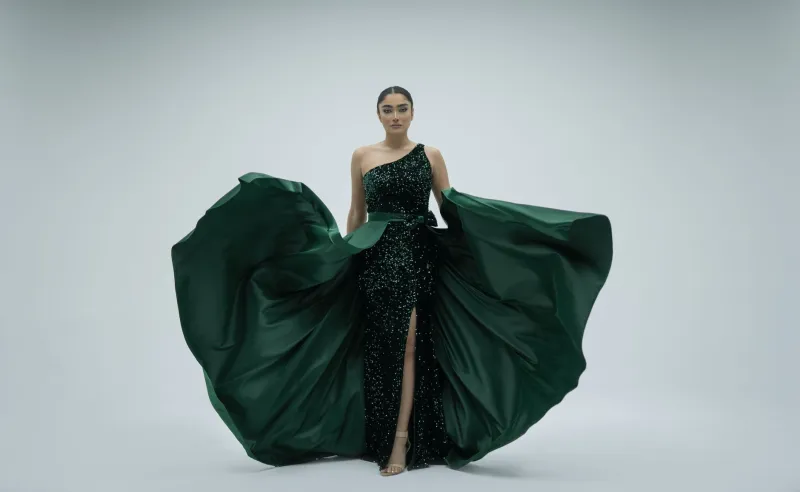
Halston understood color not as decoration but as argument. His famous Ultrasuede shirtdress arrived in earth tones and neutrals precisely because those palettes allowed the architecture of the garment to speak without competition. His evening gowns in liquid jersey moved through the spectrum with a similar economy—a single, pure tone that transformed the body into a statement rather than a canvas.
When documentary cinematographers today choose to shoot archival garments against seamless white backgrounds, or to grade their interview footage in the warm-cool register of natural stone and aged linen, they are making the same argument Halston made at his cutting table. Color, used with discipline, amplifies rather than distracts. It creates the condition for genuine attention.
Negative Space as Narrative Device
Perhaps the most sophisticated borrowing from Halston's vocabulary is the documentary world's embrace of negative space—not merely as a compositional technique but as a storytelling instrument.
In Halston's garments, the space around the body was as considered as the fabric against it. A bare shoulder, an unadorned neckline, the deliberate simplicity of an unembellished hem—these absences were not oversights. They were decisions, as intentional and as meaningful as any positive element in the design.
The most accomplished fashion documentaries now operate on the same principle. Silence is permitted to accumulate. A single photograph is held on screen long enough to be truly seen rather than merely processed. An interview subject's pause is not cut away from but honored, allowed to breathe. The frame contains empty space that the viewer's imagination is invited to fill.
This is a radical departure from the earlier conventions of the genre, which tended toward density—rapid cutting, wall-to-wall narration, an almost anxious accumulation of information. The shift toward restraint mirrors, with remarkable precision, the shift that Halston himself enacted within American fashion: a move away from maximalism and toward the kind of confidence that only simplicity can project.
Precision as Authority
Halston's workrooms were famously disciplined environments. The precision of his cutting, the exactness of his draping, the uncompromising standards he maintained for construction—these were not merely professional habits. They were expressions of a belief that authority in design derived from exactness rather than abundance.
That conviction has found its way into the visual language of contemporary fashion filmmaking in ways both obvious and subtle. The most authoritative fashion documentaries of the streaming era are characterized by a meticulous quality of execution—camera movements that are precisely motivated, editing rhythms that feel inevitable rather than arbitrary, sound design that supports rather than overwhelms the image. Nothing is approximate. Nothing is careless.
This standard of precision functions, for the viewer, much as Halston's construction standards functioned for the wearer: it communicates trustworthiness. When a documentary is executed with this level of care, the audience instinctively grants it authority. The form itself becomes an argument for the seriousness of the subject.
The American Inflection
It is worth noting that this aesthetic inheritance is specifically American in its character. European fashion documentary traditions have their own visual grammars, often more maximalist, more overtly theatrical, more comfortable with the language of spectacle. The restraint that defines the best American fashion documentaries—the clean lines, the trust in simplicity, the preference for the essential over the ornamental—reflects a distinctly American design sensibility.
Halston was, in this respect, the most American of designers. He drew on a tradition of pragmatic elegance that ran from Claire McCardell through Mainbocher, and he distilled it into a vision so pure and so confident that it became, for a generation, the definition of what American style could aspire to be. The documentary filmmakers who have inherited his visual grammar are, whether they know it or not, continuing that tradition.
The Template That Endures
Fashion moves in cycles, and the documentary genre is not immune to trend. There will always be filmmakers who prefer noise to silence, accumulation to subtraction, spectacle to precision. But the most enduring fashion documentaries—the ones that feel authoritative and timeless rather than dated and breathless—will continue to draw, implicitly or explicitly, from the well that Halston dug.
His philosophy was never merely about clothing. It was about the relationship between form and meaning, between what is shown and what is withheld, between the confidence to simplify and the discipline to sustain that simplicity under pressure. These are the qualities that make a garment legendary. They are, it turns out, also the qualities that make a documentary last.
Where fashion becomes legend on screen, Halston's grammar is almost always present—in the measured cut of the edit, in the clean architecture of the frame, in the eloquent silence between one image and the next.