Inheriting the Minimalist Crown: How Today's Designers Measure Themselves Against Halston's Standard
There is a particular kind of ambition that does not announce itself loudly. It arrives in the cut of a sleeve, in the deliberate absence of ornamentation, in the conviction that a single seam placed with precision can communicate more authority than an entire season's worth of embellishment. That was Halston's proposition to American fashion in the 1970s, and it remains, with remarkable persistence, the proposition that some of the most consequential designers working today still find themselves either honoring or quietly arguing against.
The question worth asking in 2024 is not merely whether Halston's influence endures — it plainly does — but rather what that influence actually demands of the designers who claim it. Is invoking Halston's name an act of genuine creative inheritance, or has it become something closer to a credential, a shorthand that confers sophistication without necessarily requiring the discipline that produced it?
The Blueprint That Would Not Fade
Halston's design philosophy was, at its core, a philosophy of confidence. He believed that a woman's body, in motion, was the most compelling element in any room, and that the garment's purpose was to participate in that motion rather than compete with it. His bias-cut jerseys, his ultrasuede shirtdresses, his cashmere coordinates — each piece was engineered to move with its wearer rather than impose a silhouette upon her.
That principle did not belong exclusively to the 1970s. It found its way, with varying degrees of self-awareness, into the collections of Calvin Klein through the 1990s, into the early work of Francisco Costa, and into the sustained aesthetic of Narciso Rodriguez, who has spoken openly about the influence of American minimalism on his approach to drape and structure. Rodriguez's evening wear, in particular, carries an unmistakable kinship with Halston's idiom: the body-conscious cut, the reliance on the inherent quality of the fabric, the resistance to decorative distraction.
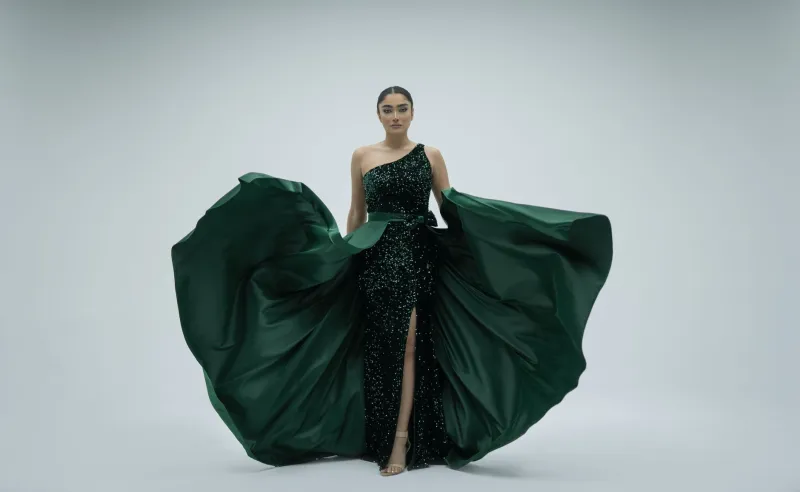
More recently, the designer Brandon Maxwell — himself a former stylist with deep roots in the world of celebrity dressing — has articulated a vision of American femininity that owes a considerable debt to the Halston archive. Maxwell's evening collections frequently return to the vocabulary of the fluid column gown, the one-shoulder construction, and the kind of studied understatement that reads as effortless on screen precisely because it required extraordinary technical effort to achieve.
What Stylists Are Actually Saying
Among the professionals who bridge the gap between fashion and cinema, Halston's name surfaces with a frequency that is itself instructive. Celebrity stylists working in Los Angeles and New York — those responsible for dressing clients at the Academy Awards, the Met Gala, and the major television premieres that now function as their own species of red carpet event — describe a consistent dynamic: when a client wants to project authority without spectacle, the conversation almost inevitably circles back to Halston as the reference point.
The logic is cinematic as much as it is sartorial. A Halston-informed gown does not compete with the camera. It collaborates with it. The clean lines read clearly in photographs. The absence of heavy beading or structural exaggeration means the garment translates across different lighting conditions, from the harsh flash photography of the press line to the warmer, more atmospheric lighting of the ceremony itself. Stylists describe this quality as "camera intelligence" — a property that Halston understood intuitively and that his contemporary inheritors pursue with varying degrees of success.
The challenge, as several stylists have noted in industry conversations, is that minimalism is simultaneously the most copied and the most frequently misunderstood aesthetic in luxury fashion. Stripping away decoration is not, by itself, a design act. What Halston understood — and what separates the designers who genuinely carry his legacy from those who merely reference it — is that reduction without mastery produces poverty rather than elegance. The discipline required to make nothing look like everything is among the most technically demanding propositions in the craft.
The Runway Evidence
A survey of recent New York Fashion Week collections reveals the breadth of Halston's ongoing influence, even when his name goes unspoken. The Spring 2024 collections from several established American houses returned, with notable consistency, to the vocabulary of fluid eveningwear, relaxed suiting with impeccable internal structure, and the kind of daywear that blurs the boundary between ease and formality — a blurring that Halston essentially invented for the American market.
Telfar Clemens, working from a different cultural position and with different materials, nonetheless shares with Halston a commitment to democratic accessibility within a framework of genuine design integrity. The parallel is not one of direct quotation but of philosophical alignment: the conviction that luxury ought to be defined by quality of thought rather than exclusivity of access.
At the more traditional end of the luxury spectrum, the house of Carolina Herrera has maintained a consistent dialogue with the American minimalist tradition, particularly in its eveningwear, where the construction principles that Halston refined — the strategic use of weight in fabric, the placement of a single structural element to anchor an otherwise fluid garment — remain visible in the technical approach of each successive creative director.
Revolutionary or Expected?
The harder question, and the one that the fashion press has been circling for several seasons, is whether Halston's minimalist approach retains its revolutionary character or has become so thoroughly absorbed into the language of luxury that it no longer carries a charge. The argument for the latter is not without merit. American minimalism is now, in a meaningful sense, the default register of high-end fashion. The designers who defined it — Halston, Klein, Donna Karan — were working against a backdrop of maximalism that gave their restraint its force. Today, restraint is the expectation.
And yet there is a counter-argument, one that the most compelling contemporary designers seem to be making through their work rather than their words. The expectation of minimalism has not diminished the difficulty of executing it well. If anything, the ubiquity of the aesthetic has raised the stakes. When every luxury brand claims the vocabulary of simplicity, the ones who genuinely command it become more visible, not less.
Halston's formula, it turns out, was never simply about removing things. It was about understanding, with absolute clarity, what remained. That understanding — rare in his era, no less rare today — is precisely what the designers chasing his standard are still reaching for. The crown, as it were, remains in the air.