Before the Streaming Era, There Was Halston: How One American Designer Rewired Television's Visual Language

There is a moment in virtually every prestige television production when a character enters a room and the camera lingers — not on the face, not on the dialogue, but on the cut of the clothing. The silhouette does the speaking. The garment carries the weight of ambition, power, or devastation. That grammar did not emerge from a writers' room. It was stitched into American visual culture decades earlier, in a studio on East 68th Street in Manhattan, by a man named Roy Halston Frowick.
Halston's influence on film has been well documented, celebrated in documentaries, dramatized in Ryan Murphy's lauded miniseries, and analyzed in retrospectives from the Metropolitan Museum of Art to the Academy of Motion Picture Arts and Sciences. What receives considerably less attention — and deserves considerably more — is the quiet, persistent, and transformative effect his design philosophy has had on television specifically. Not merely in the costumes that appear on screen, but in the very way the medium learned to use fashion as a storytelling instrument.
The Grammar of Restraint
To understand Halston's television legacy, one must first understand what made his aesthetic so philosophically distinct. At a moment in American fashion when maximalism reigned — when embellishment, volume, and decoration were considered the hallmarks of luxury — Halston made the radical argument that removal was the highest form of refinement. A dress that did nothing unnecessary. A line that went exactly where it needed to go and nowhere else. Fabric that responded to the body rather than imposing upon it.
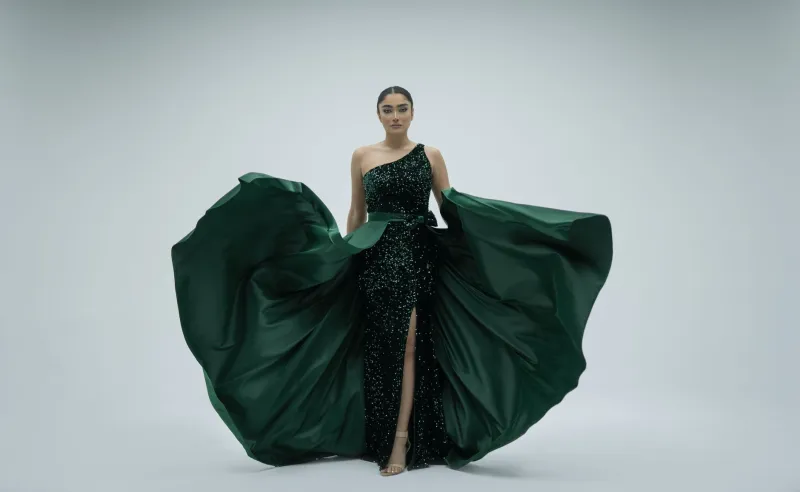
This was not minimalism for its own sake. It was minimalism as authority. The woman wearing Halston was not decorated; she was defined. And that distinction translated to the screen with extraordinary efficiency. Where ornate costuming demands the viewer decode layers of visual information, a Halston-inflected silhouette communicates instantly. Power. Composure. Control.
Television, with its smaller frame, faster pacing, and episodic structure, is a medium that rewards exactly this kind of visual efficiency. A costume that reads across a living room from a 55-inch screen in under two seconds is a costume doing serious dramatic work. Halston understood this principle before the medium fully understood itself.
Costume Designers and the Halston Shorthand
Speak with virtually any American costume designer working in prestige drama today, and the name Halston surfaces with remarkable consistency — not always as a direct reference, but as a foundational orientation. His work functions as a kind of north star: a point from which designers calibrate questions of line, proportion, and the relationship between clothing and character.
The logic is straightforward. When a production needs to signal that a female character possesses genuine authority — not performed femininity, not decorative presence, but actual structural power — the instinct is almost universally toward restraint. Clean lines. Considered silhouette. Fabric that moves with intention. That instinct has a lineage, and Halston stands near its origin.
This is particularly evident in how contemporary television handles the wardrobes of professional women in positions of influence. The boardroom aesthetics of prestige dramas from the past decade — the deliberate understatement of a character who has nothing to prove — owe a measurable debt to the vocabulary Halston introduced. His designs taught American visual culture that a woman in a beautifully cut column of matte jersey could command more attention than one in an elaborately constructed gown. That lesson has been absorbed so thoroughly that it now feels instinctive. It is not. It was learned.
The Streaming Revolution and the Halston Revival
The arrival of streaming platforms fundamentally altered the conditions under which fashion history could be told on screen. Longer formats, higher production budgets, and the capacity to reach global audiences simultaneously created a new appetite for the kind of deep biographical storytelling that Halston's life demands. Ryan Murphy's 2021 Netflix miniseries Halston, starring Ewan McGregor, was the most visible expression of this moment — but it was also a catalyst.
The production's costume design, which required recreating specific garments from Halston's archives while also extrapolating his aesthetic logic into new pieces, forced an entire creative team to engage rigorously with what his visual language actually meant. The result was not merely a period drama in period costumes. It was a master class in how clothing communicates character, aspiration, and decline across a narrative arc. The show's wardrobe functioned as a second script.
Its influence on subsequent productions has been tangible. In the years since, there has been a discernible shift in how streaming dramas approach fashion-adjacent storytelling — a greater willingness to let costume carry dramatic weight, a more sophisticated understanding of how a single garment can crystallize a character's interior life. Halston, both the man and the miniseries, accelerated that evolution.
The Small Screen's Debt to a Large Vision
What makes Halston's television legacy particularly compelling is its indirectness. He did not design for television. He did not, by most accounts, spend significant creative energy thinking about the medium. His concerns were the body, the fabric, the woman, and the moment. Yet precisely because his aesthetic operated at the level of fundamental principles rather than trend-dependent surface choices, it translated across media in ways that more time-bound design philosophies could not.
The shows that most successfully deploy Halston-inflected visual logic are rarely the ones explicitly referencing him. They are the productions where a character's clothing has been so thoughtfully considered that it seems to exist in the same moral and psychological universe as the performance itself. Where the cut of a jacket tells you something the dialogue has not yet revealed. Where simplicity functions as the most complex statement in the room.
That is Halston's enduring contribution to the small screen: the understanding that in fashion, as in drama, what you choose not to say is often the most powerful thing you communicate.
A Legacy Still Being Written
American television is currently experiencing what cultural critics have begun to call a second golden age of fashion storytelling — a period in which costume design is receiving the critical attention and awards recognition that it has long deserved. In this context, the conversation about Halston's influence is not historical. It is contemporary and ongoing.
As new productions continue to reach for the visual grammar of authority, sophistication, and restraint, they reach — whether they know it or not — toward a vocabulary that one designer spent a career constructing. The legend does not reside only in the archives, in the photographs from Studio 54, or in the streaming dramatizations of his life. It lives in every clean line, every deliberate silhouette, every moment when television chooses understatement and trusts the audience to understand what that choice means.
Halston understood that fashion was never merely decoration. On the screen, large or small, that understanding remains the most powerful inheritance he left behind.