When Silence Speaks Louder Than Sequins: How Halston Rewired the Visual Grammar of Fashion on Screen
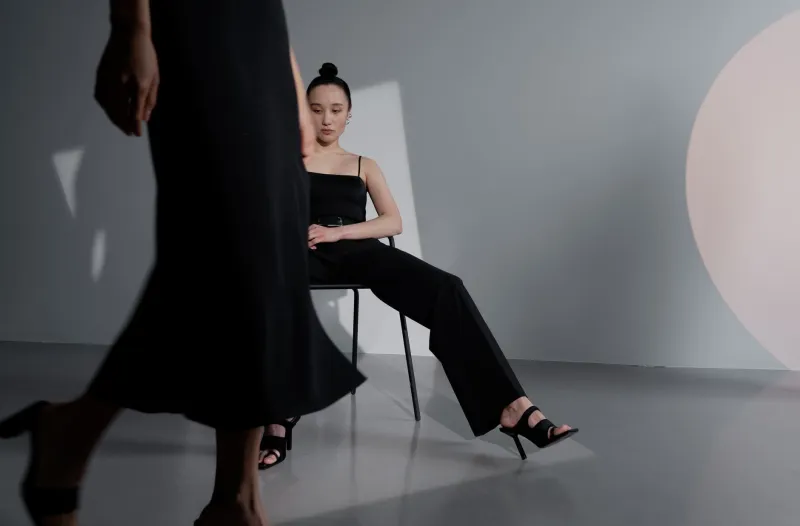
There is a particular kind of power in what is not shown. A frame held a beat too long. A garment allowed to move without commentary. A silhouette caught against negative space, needing nothing else to complete its argument. These are the visual tools that define the most celebrated fashion storytelling of the modern era — and their origins, traced carefully enough, lead back to a single designer working out of a studio on East 68th Street in Manhattan.
Halston did not set out to write a manual for filmmakers. He set out to make women look extraordinary through the radical act of taking things away. But in doing so, he established a visual and philosophical framework so precise, so internally consistent, that it became impossible for anyone trying to capture fashion on screen to ignore it. The Halston effect, as it might reasonably be called, is not a trend. It is a grammar — and it has been quietly governing the way fashion stories are told on screen for decades.
The Philosophy That Changed the Frame
To understand what Halston contributed to visual storytelling, one must first understand what he was reacting against. American fashion in the late 1960s was, by most accounts, still heavily indebted to European ornamentation — a world of structured silhouettes, embellishment, and visible effort. Halston looked at that tradition and proposed something almost heretical: that the body itself was the primary design element, and that the garment's highest achievement was to honor it without interruption.
This was not laziness or simplification for its own sake. It was a deeply considered philosophical position. Halston's Ultrasuede shirtdress, his fluid jersey gowns, his cashmere separates — each piece was the result of rigorous editing, of removing every element that did not serve the essential relationship between fabric and form. The seams were hidden. The closures were minimal. The structure was internal. What remained on the surface was pure.
When filmmakers began grappling with how to represent this kind of design on screen, they quickly discovered that conventional fashion cinematography — close-ups of embroidery, sweeping shots of elaborate construction, narration that catalogued detail — was almost useless. Halston's work demanded a different approach. It asked the camera to trust the viewer, to allow meaning to accumulate slowly, to resist the impulse to explain.
Negative Space as Narrative Device
The concept of negative space — the deliberate use of emptiness to define and elevate what is present — has been central to visual art for centuries. But in the context of fashion filmmaking, its systematic application as a narrative tool is a relatively recent development, and it bears the unmistakable fingerprints of the Halston aesthetic.
Contemporary fashion documentaries have increasingly adopted compositional strategies that would have been considered almost austere by earlier standards. Subjects are often filmed against unadorned backgrounds. Garments are displayed in motion rather than in static close-up, allowing the behavior of the fabric — the way it falls, catches light, responds to the body — to carry the visual argument. Silence and ambient sound replace explanatory voiceover in key sequences. These choices are not accidental; they reflect a learned understanding that restraint, applied with intention, generates a specific kind of cinematic authority.
This is the legacy Halston left for the screen: not a set of images to reproduce, but a set of principles to apply. Understatement as emphasis. Reduction as revelation. The space around the thing as part of the thing itself.
Prestige Television and the Minimalist Turn
The influence of this aesthetic extends well beyond documentary filmmaking. The emergence of prestige television as a serious storytelling form in the early 2000s coincided with a broader cultural appetite for visual restraint — a turn away from the maximalism of 1980s and 1990s production design toward something cooler, more considered, more architecturally precise.
Fashion-adjacent dramas and limited series began to reflect this sensibility in their costuming and visual language. The decision to dress characters in clean lines and muted palettes was not merely a stylistic choice; it was a narrative one. Clothing became a means of communicating interiority — of suggesting, rather than stating, something essential about who a character was and what they desired. This is a fundamentally Haltonian idea: that what a person wears should tell you something true about them without requiring explanation.
Ryan Murphy's 2021 miniseries about Halston himself demonstrated this principle with particular clarity. The production's visual choices — its long, uninterrupted takes of Ewan McGregor inhabiting a character defined by stillness and control, its deliberate use of empty rooms and spare interiors — were not merely biographical accuracy. They were an argument about how to translate a design philosophy into cinematic language. The show's aesthetic was, in a meaningful sense, a Halston garment: structured on the inside, immaculate on the surface, saying everything through what it chose not to show.
The Documentarian's Dilemma and Its Resolution
For documentary filmmakers, the challenge of representing Halston's work on screen has always involved a fundamental tension. Documentary grammar traditionally relies on accumulation — interviews, archival footage, contextual detail, expert testimony — to build understanding. But Halston's work resists accumulation. It is, by design, anti-accumulative. Its meaning is generated by removal, not addition.
The most successful documentary treatments of Halston's legacy have resolved this tension by turning the dilemma into a structural choice. Rather than explaining the work, they enact it. They allow the camera to rest on a garment without commentary. They resist the urge to fill silence with narration. They trust the viewer to bring their own attention to bear on what is present — which is, of course, exactly what Halston trusted his clients to do.
This represents a genuine shift in documentary practice, one that can be traced directly to the demands of the subject matter. Halston did not simply give filmmakers a new aesthetic to admire; he gave them a new methodology to adopt.
The Enduring Standard
What makes the Halston effect so durable as a cinematic influence is that it is not dependent on period accuracy or nostalgic reproduction. It is a set of principles — about reduction, about trust, about the communicative power of restraint — that can be applied to any story told on screen.
Contemporary designers who work in a minimalist tradition, from Jil Sander to The Row, have found that their work generates a similar cinematographic response: it asks the camera to slow down, to observe rather than explain, to find meaning in movement and material rather than in decoration. The visual vocabulary that Halston established has become, in this sense, a shared inheritance — a standard against which fashion storytelling continues to measure itself, whether or not the name is ever spoken aloud.
In the grammar of fashion on screen, Halston remains the most essential sentence. Everything else is elaboration.