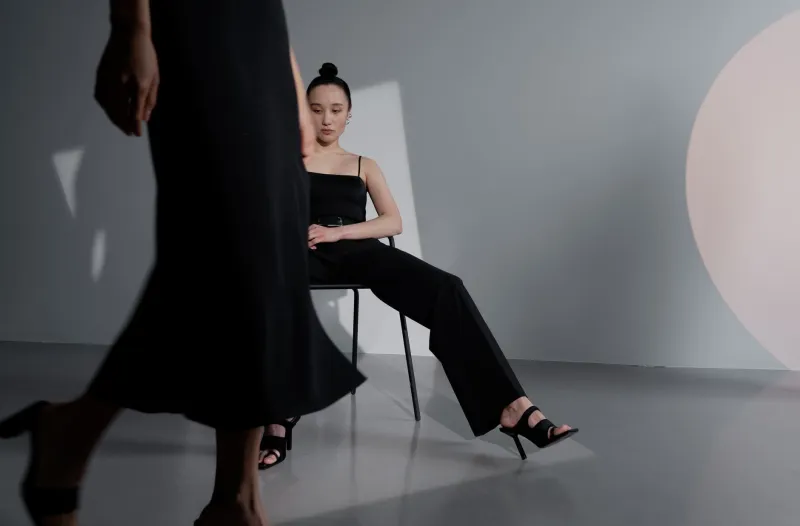
Stripping the Frame: How Halston's Principle of Elimination Is Rewriting Hollywood's Costume Playbook

There is a particular discipline required to dress a character in almost nothing — and make that nothing feel like everything. It is a discipline that Halston, the Midwestern-born designer who transformed American fashion during the 1970s, understood with an almost ruthless clarity. His conviction that a garment achieves its highest purpose only after every superfluous element has been excised was not merely an aesthetic preference. It was a philosophy of power. And today, decades after his most iconic collections were unveiled, that philosophy is being studied, annotated, and applied with remarkable precision by the costume designers shaping the most critically discussed films and television series in the United States.
The movement is neither accidental nor nostalgic. It is strategic.
The Archive as Classroom
For working costume designers, the Halston archive — portions of which are held at institutions including the Museum at the Fashion Institute of Technology in New York — functions less as a historical record and more as a living curriculum. The garments preserved within those collections demonstrate, in physical form, what no textbook can adequately convey: that restraint is not the absence of intention but rather its most concentrated expression.
Designers who have spent time with those pieces describe a consistent revelation. The construction is immaculate, the material choices deliberate to the point of severity, and the silhouette reduced to its absolute essence. What remains after Halston's editorial process is a garment that communicates with the efficiency of a single, perfectly placed word in an otherwise sparse sentence. For costume designers tasked with building a character's interior life through exterior choices, that efficiency is not merely appealing — it is instructive.
The practical application begins at the script stage. Rather than approaching a character's wardrobe as an opportunity for visual elaboration, designers trained in Halston's methodology ask a different question first: what does this character need to stop wearing? The removal of a belt, the elimination of pattern, the substitution of a draped jersey for a structured jacket — each subtraction becomes a narrative choice, and narrative choices accumulate into psychological portraits.
Character Depth Through Deliberate Absence
Consider the dramatic arc available in a single wardrobe transition. A character who begins a story in layered, heavily accessorized clothing and gradually moves toward cleaner, more austere silhouettes communicates an internal journey without a single line of dialogue. The audience registers the shift viscerally, often before they consciously identify its source. This is precisely the mechanism Halston's design philosophy makes available to contemporary filmmakers.
In recent prestige productions — particularly those that have attracted awards attention for their costume work — this approach has become increasingly visible. The deliberate understatement of a protagonist's wardrobe in a high-stakes corporate narrative, for instance, can convey authority more effectively than an elaborate costume ever could. The character who requires no ornamentation to command a room is, by cinematic logic, the most dangerous person in it. Halston understood this intuitively. His dresses for figures like Liza Minnelli and Bianca Jagger were not understated because the budget was limited. They were understated because he recognized that a woman in a perfectly cut column of matte jersey needed nothing more to occupy every available inch of a room's attention.
Current designers working within major studio productions have articulated this principle in terms that echo Halston's own recorded statements about his craft. The goal, as one perspective within the field consistently frames it, is to achieve maximum psychological impact through minimum visual information. When a costume carries too much — too much color, too much texture, too much structural complexity — it competes with the performance. When it carries precisely the right amount and nothing more, it amplifies the performance without announcing its own presence.
The Silhouette as Psychological Instrument
Halston's specific contribution to this evolving strategy extends beyond mere minimalism as a general principle. His particular innovation was the understanding that silhouette — the shape a garment creates against the body — functions as a primary carrier of meaning, while surface decoration is secondary at best and distracting at worst. This hierarchy has profound implications for costume design in the age of high-definition cinematography.
On contemporary screens, where every thread and texture is rendered with documentary precision, surface complexity can overwhelm a frame. A heavily embellished garment that reads as magnificent in a theater or on a runway can, under the scrutiny of a 4K close-up, become visual static. The silhouette, by contrast, reads cleanly at every scale — in a wide establishing shot, in a medium two-shot, and in the intimate close-up where emotional performance lives. Designing primarily through silhouette, as Halston consistently advocated and practiced, is therefore not merely an aesthetic preference in the contemporary production environment. It is a technical solution.
This understanding has filtered into the working methodology of designers across the industry. The initial costume sketches for major characters in prestige productions increasingly prioritize silhouette clarity above all other considerations, with material, color, and finish treated as refinements rather than foundations. It is a reversal of the traditional hierarchy that once governed costume design, and its intellectual origin traces directly to Halston's insistence that the body's line, unencumbered by decoration, was the most eloquent statement a designer could make.
From the Studio to the Screen
The broader cultural significance of this shift extends beyond the technical craft of costume design. It reflects a maturing relationship between fashion history and cinematic storytelling — a recognition, growing steadily within the industry, that the great designers of the twentieth century were not merely creating clothes but developing visual languages that carry meaning across decades and media.
Halston's language, in particular, has proven remarkably durable. Its principles translate from the runway to the screen with minimal adaptation because they were never primarily about the fashion moment that produced them. They were about the human body, the weight of fabric against skin, the geometry of movement, and the communication of interior states through exterior form. These concerns are as relevant to a costume designer working on a contemporary limited series as they were to a designer outfitting the most photographed women in America during the Studio 54 era.
For audiences who encounter Halston's legacy through the growing body of film and documentary work dedicated to his life and influence — including Ryan Murphy's celebrated Netflix miniseries and the archival footage that continues to surface in fashion documentaries — there is a particular satisfaction in recognizing that his principles are not merely being preserved but actively deployed. The designer who built his reputation on the radical act of taking things away continues, in the most practical sense, to shape the way American cinema dresses its most compelling characters.
The elimination, it turns out, was never finished. It is ongoing, and it is deliberate, and it is more influential now than perhaps even Halston himself anticipated.