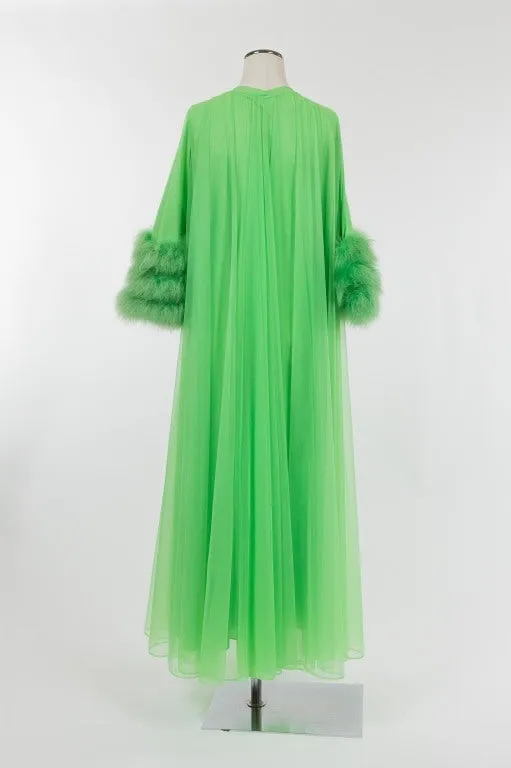
Principled by Design: How Halston's Refusal to Bend Rewrote the Rules of Hollywood's Fashion Partnerships
There is a particular kind of power that does not announce itself through volume or aggression. It arrives quietly, through refusal. Halston understood this instinctively, and it was precisely that understanding — the disciplined, almost architectural conviction that certain boundaries should never be crossed — that made him one of the most disruptive forces American fashion has ever produced. Not disruptive in the way the industry typically celebrates, with viral moments and spectacle, but disruptive in the way that genuinely reshapes the structural assumptions of an entire field.
Decades after his peak influence, the fashion-Hollywood complex now operates according to a set of unwritten protocols that trace their origins, in no small part, to the precedents Halston either established or forced others to establish in reaction to him.
The Architecture of Refusal
To understand what Halston changed, one must first appreciate what he was refusing. By the early 1970s, American fashion was in the early stages of a transformation that would eventually commodify nearly every aspect of a designer's identity. Licensing deals were presented not as compromises but as opportunities — the logical extension of a brand into new markets, new price points, new audiences. For many designers, the arrangement proved irresistible.
Halston saw it differently. His aesthetic was not a product to be reproduced at scale; it was a philosophy, and philosophies do not survive translation into mass-market polyester without losing something essential. His resistance to deals that would dilute the integrity of his name was not stubbornness for its own sake. It was a coherent creative position, one that treated the relationship between a designer's vision and the objects bearing that vision as something close to sacred.
The infamous arrangement with JCPenney in 1983 — a partnership ultimately imposed rather than freely chosen, and one that led directly to his expulsion from Bergdorf Goodman — stands as the cautionary counterpoint to everything he had previously protected. When the boundary finally broke, the consequences were swift and severe. The lesson was not lost on those watching.
What the Studios Learned, Slowly
Hollywood's early relationship with fashion designers was transactional in the most uncomplicated sense. Studios required costumes; designers provided them. The question of creative authority was largely settled in the studio's favor. A designer's aesthetic sensibility was a resource to be extracted, not a perspective to be honored.
Halston's presence in celebrity circles — dressing Liza Minnelli, Bianca Jagger, Elizabeth Taylor, and a constellation of other luminaries whose public appearances functioned as cultural events — introduced a different model. These were not costume assignments. They were collaborations premised on mutual respect for the designer's vision. When Halston dressed a woman for a public appearance, the garment was not adjusted to suit external expectations; the context was expected to rise to meet the garment.
This inversion of the conventional power dynamic was quietly radical. It suggested that a designer's creative authority was not a courtesy to be extended at the studio's discretion but a precondition of genuine collaboration. The women who wore Halston understood this. Increasingly, so did the institutions that sought access to his work.
The Blueprint That Luxury Houses Now Follow
Contemporary luxury fashion's approach to Hollywood partnerships bears unmistakable traces of the framework Halston's career made legible. The creative control clauses now standard in major red carpet agreements, the careful curation of which projects and personalities a house will associate with, the deliberate resistance to overexposure — these are not innovations of the social media era. They are refinements of principles that Halston's career illustrated, sometimes through triumph and sometimes through the brutal clarity of its most painful chapters.
When Chanel declines a partnership that does not align with the house's aesthetic direction, or when a major Italian atelier insists on final approval over how its garments are presented in a film production, the logic animating those decisions is recognizably descended from the position Halston occupied. The specific terms have evolved; the underlying conviction that creative integrity is non-negotiable has not.
The streaming era has intensified rather than diminished these dynamics. As fashion documentaries and dramatizations have become prestige content in their own right — Ryan Murphy's celebrated Netflix miniseries being perhaps the most prominent recent example — the question of how a designer's legacy is represented has acquired new commercial and cultural stakes. Houses now engage with these productions not as passive subjects but as active participants with defined interests in the resulting narrative. That posture of engaged, principled participation has a genealogy, and Halston's name appears near its origin.
The Celebrity-Fashion Industrial Complex, Reimagined
It would be an oversimplification to credit Halston alone with transforming the celebrity-fashion relationship. The forces at work were numerous and intersecting. But his career provided a uniquely visible and dramatic illustration of what was possible when a designer refused to subordinate creative authority to commercial convenience — and what was lost when that refusal ultimately could not be sustained.
The tragedy embedded in his story is inseparable from its instructive power. Halston's eventual loss of control over his own name was not merely a personal misfortune; it was a public demonstration of the stakes involved in the negotiations between creative vision and commercial interest. Every designer who has since structured a licensing deal with protective clauses, every luxury house that has insisted on brand integrity provisions in a Hollywood agreement, has been negotiating in the shadow of that cautionary history.
What makes Halston's legacy so enduring in this context is precisely its complexity. He was neither a pure martyr to principle nor a simple cautionary tale about the perils of commercial ambition. He was a figure who held a line with extraordinary discipline for a remarkable period, who understood before most of his contemporaries that a designer's name was not merely a commercial asset but a creative statement — and who paid a severe price when the institutional forces arrayed against that understanding proved, in the end, stronger than any individual's resolve.
A Standard That Outlasted Its Architect
The most durable legacies are often those that survive the circumstances of their creation. Halston's vision of the designer-as-auteur, with the authority and the responsibility that title implies, has proven more resilient than the specific commercial arrangements that ultimately undermined his own position within it.
Hollywood's fashion collaborators today operate in a landscape he helped define. The expectation that a designer brings not merely technical skill but an irreducible creative perspective — one that cannot be adjusted to suit convenience without being fundamentally compromised — is now an industry assumption rather than a radical proposition. That shift did not happen automatically or inevitably. It happened because certain figures made it happen, through the force of their refusals as much as through the brilliance of their creations.
Halston was, in this sense, as much an architect of professional norms as he was a designer of garments. The standard he set, and the cost he bore for attempting to maintain it, remains one of American fashion's most instructive and most cinematic stories.