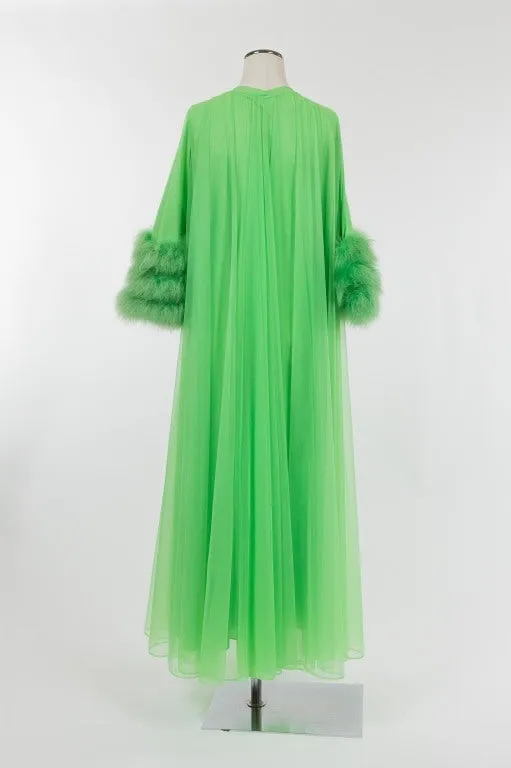
A Name That Needs No Introduction: How Halston Became Hollywood's Definitive Shorthand for Refined Elegance
There is a particular kind of cultural authority that transcends the industry in which it was earned. Coco Chanel achieved it. So did Andy Warhol. And, in a manner that continues to reverberate through Hollywood's most carefully constructed narratives, so did Roy Halston Frowick — known simply, and enduringly, as Halston. His name has become something altogether more powerful than a brand label. It has become a cinematic language.
When a contemporary screenwriter places the word "Halston" in a character's mouth, or when a costume designer reaches for one of his signature fluid silhouettes to dress a leading actress in a period drama, the gesture communicates far more than aesthetic preference. It announces something essential about that character's relationship to power, to beauty, and to the kind of effortless authority that cannot be purchased — only understood.
The Architecture of a Cultural Symbol
To appreciate how Halston's name became Hollywood's most reliable shorthand for timeless elegance, one must first understand the specific nature of his contribution to American fashion. He did not merely design clothing. He articulated a philosophy — one rooted in the belief that the female form required liberation rather than ornamentation, and that true luxury expressed itself through restraint rather than excess.
His pioneering use of Ultrasuede, his mastery of bias-cut jersey, and his insistence on garments that moved with the body rather than against it were, in their moment, genuinely revolutionary. But what has proven even more durable than his technical innovations is the sensibility they embodied: a cool, American confidence that stood in deliberate contrast to the fussier traditions of European couture.
This sensibility translated naturally to the screen. Cinema, after all, is a medium that rewards clarity of character. A Halston gown does not equivocate. It does not ask for attention so much as command it through sheer architectural precision. For filmmakers seeking to establish a character's inner life through external presentation, this quality proved — and continues to prove — invaluable.
The Filmmaker's Vocabulary
In practice, the invocation of Halston in contemporary film and television operates on several distinct levels. The most literal, of course, involves the actual incorporation of his garments into a character's wardrobe. Period productions set during the 1970s and early 1980s frequently treat authentic Halston pieces as primary documents — artifacts that locate a character within a specific stratum of New York society with an authority that no reproduction could replicate.
But the influence extends well beyond period accuracy. Costume designers working on projects set in the present day regularly describe their work in terms borrowed directly from Halston's aesthetic vocabulary. "Halston-esque" has become a recognized professional shorthand within the industry, signifying a particular combination of minimal ornamentation, fluid movement, and an almost architectural attention to silhouette. When a designer says a character should feel "like Halston," the entire wardrobe team understands the instruction immediately.
This linguistic efficiency is itself a measure of cultural impact. Names that achieve this level of professional shorthand — Hitchcock in cinematography, Brando in performance — have crossed from individual achievement into collective reference point. Halston occupies that rare position within the world of fashion and film.
Character Through Cloth
Perhaps the most sophisticated dimension of Halston's cinematic influence lies in the way his aesthetic has come to signal specific character types — or, more precisely, specific character aspirations. The woman dressed in a Halston silhouette on screen is rarely positioned as someone who seeks approval. She has, by the grammar of the costume itself, already decided that approval is beside the point.
This quality made his designs particularly resonant for Hollywood's portrayals of powerful women across multiple decades. From the boardroom dramas of the 1980s to the prestige television productions of the streaming era, the Halston aesthetic has served as a reliable visual marker for female characters who operate on their own terms. The garment does not soften them. It does not domesticate them. It announces, with quiet authority, that they have arrived.
Costume designers have noted that this communicative precision is extraordinarily difficult to achieve through other means. Elaborate costuming can overwhelm a performance. Deliberately understated dressing can read as absence of intention. The Halston approach — where every element serves the whole, and where the whole serves the person wearing it — creates a visual statement that enhances rather than competes with the actor's work.
The Documentary Dimension
The 2021 Netflix miniseries Halston, directed by Daniel Minahan and produced by Ryan Murphy, brought the designer's story to an audience that extended well beyond the world of fashion. But even before that production crystallized his biography for a new generation, documentary filmmakers had long understood that Halston's life possessed an inherently cinematic structure: the arc of the visionary, the seductions of commerce, the costs of compromise.
What those documentaries collectively established — and what the Murphy production amplified — was the degree to which Halston's personal aesthetic and his professional philosophy were inseparable. He did not design from a position of detachment. He designed from a position of absolute conviction about what beauty required. This unity of self and work is precisely the quality that translates most powerfully to screen, because cinema is ultimately a medium about conviction — about characters who believe, sometimes to their own detriment, in something larger than circumstance.
A Legacy Written in Light
The endurance of Halston's name as a cinematic reference point speaks to something fundamental about the relationship between fashion and storytelling. The most powerful designers are not simply craftspeople. They are, in the deepest sense, authors — individuals whose work creates a coherent vision of how human beings might inhabit the world. Halston's vision was one of radical simplicity, of beauty achieved through the courage to subtract rather than add.
Hollywood has recognized in that vision something it perpetually seeks: a visual language precise enough to communicate character instantly, yet supple enough to serve stories across generations and genres. The Halston aesthetic does not belong to the 1970s any more than a well-constructed sentence belongs to the century in which it was written. It belongs to anyone with the intelligence to deploy it and the discipline to trust its power.
For filmmakers, costume designers, and audiences alike, the name Halston has come to mean something specific and something enduring: the understanding that elegance is not decoration, but architecture — and that the most powerful statements are often the ones that know precisely what to leave out. In a medium built on the eloquence of images, that is perhaps the most cinematic sensibility of all.