The Invisible Curriculum: How Halston's Design Philosophy Became the Unspoken Grammar of Prestige Television
There is a particular kind of silence that expensive things make. A cashmere coat that falls without ceremony. A silk blouse that moves as though it has somewhere important to be. A room stripped of ornament, where every remaining object earns its place. Roy Halston Frowick understood this silence better than almost anyone who has ever worked in American fashion — and in the decades since his peak influence, that understanding has migrated, quietly and pervasively, into the visual language of prestige television.
The connection is rarely acknowledged in writers' rooms or production design meetings. Showrunners do not typically open their development bibles with a chapter on American fashion history. Yet the evidence is unmistakable. Across the landscape of contemporary prestige drama — from the mahogany-and-grey-flannel corridors of corporate power narratives to the cool, lacquered interiors of psychological thrillers — the Halston philosophy endures as an organizing principle, shaping the way television signals sophistication, authority, and the particular menace of old money.
The Principle of Deliberate Restraint
To appreciate Halston's influence on contemporary television, one must first understand what made his design philosophy so radical in its original context. Working in an era of maximalist excess — the beaded gowns, the ruffled excess, the competitive ornamentation of American couture — Halston arrived at a counterintuitive conclusion: that true luxury announces itself through what it withholds.
His garments were famous for their clean, uninterrupted lines. Seams that disappeared. Fabrics chosen not for decoration but for the way they collaborated with the body in motion. Color palettes that rejected novelty in favor of permanence — ivory, camel, black, the occasional devastating red. The result was clothing that communicated something more durable than fashion: it communicated the confidence of someone who has nothing left to prove.
This is precisely the visual grammar that prestige television has adopted as its native tongue. Consider the wardrobe architecture of any contemporary drama built around corporate power. The palette is invariably restrained. Textures are chosen for what they imply — weight, quality, permanence — rather than for visual excitement. Silhouettes are clean, unencumbered, and rigorously consistent with character psychology. The costume, in other words, functions exactly as Halston intended his garments to function: as an extension of the wearer's interior authority rather than a separate performance layered on top of it.
From the Atelier to the Writers' Room
The transmission of Halston's philosophy into television did not occur through a single dramatic moment of influence. It accumulated gradually, carried forward by costume designers who studied fashion history, by production designers who understood that interiors and garments speak the same visual language, and by a broader cultural absorption of what Halston represented.
By the time prestige television emerged as a distinct category in American entertainment, the Halston aesthetic had already been thoroughly processed by the fashion industry, by advertising, and by the visual culture of aspirational lifestyle media. When showrunners and their collaborators reached for a visual language to convey power and refinement, they were inevitably reaching for something that Halston had already shaped.
The influence manifests in ways both obvious and subtle. At the level of costume, it appears in the preference for investment pieces over trend-driven dressing, in the recurring use of monochromatic or near-monochromatic palettes to signal psychological coherence, and in the deliberate avoidance of decorative excess as a marker of taste. Characters who dress with Haltonian discipline are almost invariably positioned as formidable — people whose power requires no external validation.
The Architecture of Interiors
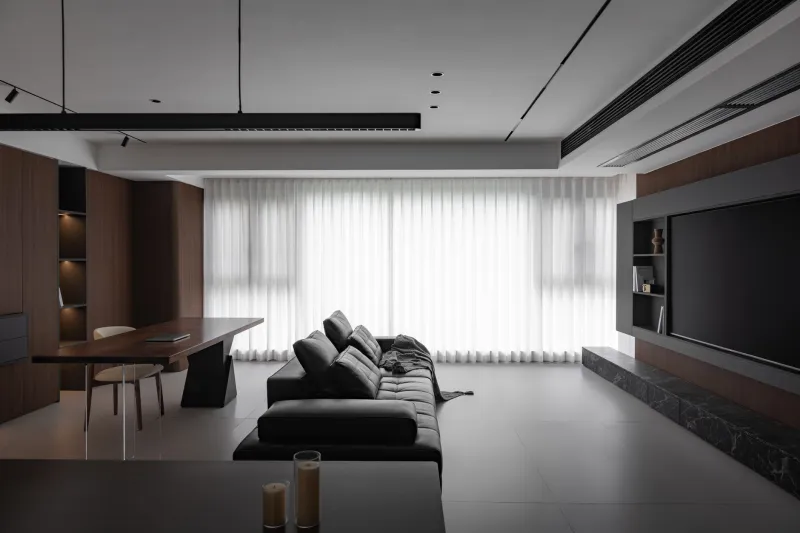
Perhaps the most underappreciated dimension of Halston's influence on prestige television is its reach beyond the wardrobe department and into the production design of the spaces characters inhabit. Halston was not merely a clothing designer; he was a complete aesthetician, and his personal environments — his Olympic Tower apartment, his Montauk retreat designed in collaboration with Paul Rudolph — were as philosophically coherent as his garments.
The principles governing those spaces — negative space as a form of luxury, material quality as the primary decorative gesture, the elimination of the superfluous — have become the defining characteristics of the prestige television interior. The corporate suites, the Upper East Side apartments, the Hamptons compounds that populate contemporary drama are almost universally conceived according to a logic Halston would have recognized immediately: restraint as the most eloquent form of display.
Production designers working on high-end American television series have spoken, in various interviews, about the challenge of creating environments that communicate wealth without appearing vulgar. The solution they consistently arrive at — fewer objects, better objects, more deliberate arrangement of space — is, at its core, a Haltonian solution.
Power Dressing Reimagined for the Streaming Age
The concept of power dressing has a complicated history in American popular culture, most often associated with the shoulder-padded maximalism of the 1980s. What Halston offered was something fundamentally different: not the performance of power through volume and ornamentation, but the expression of power through absolute control.
This distinction has proven enormously useful for prestige television, which operates in a cultural moment deeply skeptical of theatrical self-presentation. The most compelling characters in contemporary drama — the ones audiences find genuinely formidable rather than merely loud — tend to dress according to Haltonian principles. Their clothing does not shout. It does not compete with their presence. It simply confirms, without argument, that they belong exactly where they are.
Costume designers working on prestige productions have increasingly articulated this philosophy in terms that echo Halston's own stated principles. The goal is not to dress a character in impressive clothing; it is to find the garments that make costume invisible — that allow the character's authority to occupy the full space of the scene without visual interference.
Why This Matters for How We Watch
For audiences, understanding the Halston halo effect offers a genuinely illuminating lens through which to experience contemporary prestige television. The visual choices that feel most authoritative and most sophisticated on screen are, in many cases, the direct descendants of a design philosophy articulated in the ateliers of 1970s New York.
When a character in a corporate drama appears in a perfectly cut camel coat against a spare, high-ceilinged interior, the effect is not accidental. It is the product of a visual tradition that Halston did more than perhaps any other American designer to establish — the tradition that equates restraint with power, and that locates genuine luxury not in accumulation but in the discipline of the perfectly chosen.
For those who have followed Halston's story through the films, documentaries, and biographical narratives that have brought his legend to new generations, this pervasive influence represents something more than a footnote in fashion history. It is evidence that the most enduring design philosophies do not merely dress their moment — they teach subsequent generations how to see.