The Fitting Room Revolution: How Halston Taught Hollywood's Leading Ladies to Demand More
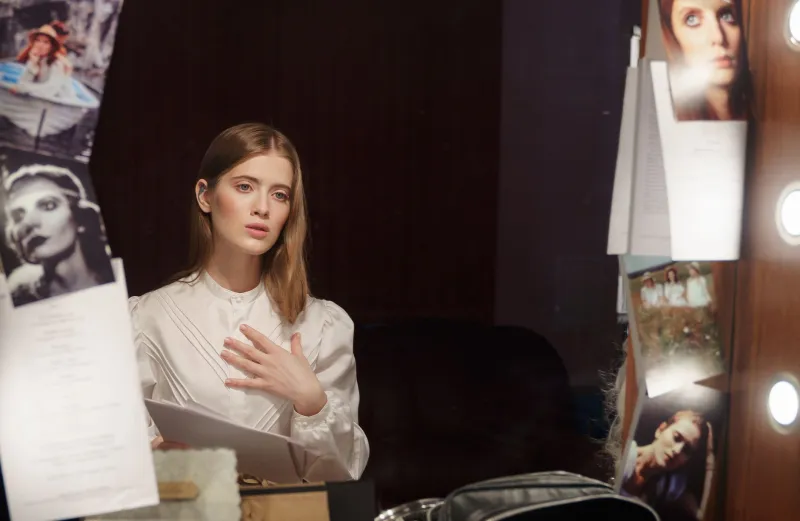
There is a moment in nearly every great fitting — a pause, a breath, a half-turn toward the mirror — when a woman stops being a subject and becomes a collaborator. Halston understood that moment instinctively. Long before the language of creative partnership entered Hollywood's wardrobe departments, he was already practicing it on the women who came to his Olympic Tower salon, transforming what had traditionally been a service transaction into something closer to a conversation between equals. That philosophy, quietly radical in its time, eventually made its way onto sound stages and into the consciousness of a generation of actresses who would never accept a passive relationship with their costumes again.
The Architecture of Trust
To understand why Halston's influence on Hollywood's dressing culture runs so deep, one must first understand what he was reacting against. Mid-century American fashion — even at its most glamorous — treated the female body as a structural problem to be solved. Seams, boning, and elaborate underpinnings conspired to manufacture a silhouette rather than reveal the one that already existed. Women were, in a very literal sense, constructed into their clothing.
Halston's answer was architectural in its own right, but the architecture served the body rather than overriding it. His reliance on fluid jerseys, supple ultrasuede, and precisely draped cashmere allowed a garment to move in sympathy with its wearer. The dress did not command the body; it listened to it. For the actresses and cultural figures who experienced this firsthand — Liza Minnelli, Bianca Jagger, Marisa Berenson among them — the effect was not merely aesthetic. It was psychological. To be dressed by Halston was to be trusted with your own appearance, and that trust proved profoundly difficult to surrender once it had been extended.
When the Philosophy Crossed the Camera Line
The crossover between Halston's couture world and Hollywood's working wardrobe departments was neither immediate nor direct. It moved the way most cultural revolutions do — gradually, through the testimonies of women who had been changed by an experience and could not stop speaking about it. As those women became more prominent fixtures of American cultural life throughout the 1970s and into the 1980s, their expectations traveled with them onto film sets and into the dressing rooms of major studios.
Contemporary costume designers working in prestige film and television frequently cite a traceable shift in how leading actresses began to engage with wardrobe conversations during this period. The fitting appointment, once a largely administrative affair in which measurements were taken and decisions handed down, began to evolve into something with more negotiation built into it. Actresses asked questions about fabric. They requested that silhouettes be reconsidered. They arrived with references, opinions, and — increasingly — a vocabulary borrowed from the world of fashion proper rather than from theatrical costuming.
This was Halston's influence working at a remove. Women who had worn his clothes, or who had watched women they admired wearing them, had absorbed a new standard. Elegance, they now understood, was not something imposed from without. It was something uncovered from within, and the designer's — or costume designer's — job was to facilitate that discovery rather than to perform it on the actress's behalf.
The Language of Collaboration
What makes Halston's legacy particularly durable within Hollywood's wardrobe culture is that he did not simply produce beautiful garments. He produced a methodology, and methodologies outlast their originators in ways that individual pieces rarely do.
The core of that methodology was radical simplicity: know the body, trust the body, and resist the temptation to overwhelm it with ornamentation that draws attention to the designer's hand rather than the wearer's presence. Applied to film costuming, this translates into a set of principles that the industry's most respected practitioners continue to invoke. A costume that fights an actress's natural movement will always read as a costume on screen. A garment that works with her physicality disappears into her performance — which is, paradoxically, precisely when clothing becomes most powerful cinematically.
Costume designers who have worked with major studio productions across the past two decades speak consistently of actresses who arrive at fittings with a Halston-inflected sensibility, even when they cannot name it as such. They want to feel unencumbered. They want to move without restriction. They want the camera to find them rather than their wardrobe. These are desires shaped, at least in part, by a cultural inheritance that traces back to a workroom on West 54th Street and the philosophy of a designer who believed that a woman's own silhouette was always the most compelling one available.
The Democratization of a Standard
One of the more quietly significant aspects of Halston's influence on Hollywood's dressing culture is its democratic character. His work was expensive — often extraordinarily so — but the philosophy it embodied was not proprietary. Any designer willing to listen carefully, to prioritize the wearer's comfort and confidence over the garment's conceptual ambition, could practice it. And as that philosophy spread through the culture, it raised the floor of what actresses across the industry — not just the most celebrated among them — felt entitled to expect.
The ripple effects are visible in how contemporary productions approach their fitting processes. Extended consultation periods, fabric testing before final construction, and genuine dialogue between costume designers and performers about character motivation as expressed through clothing — these have become increasingly standard practices on prestige productions. They reflect an industry that has, slowly and somewhat unconsciously, absorbed Halston's central conviction: that the woman wearing the dress is not the last variable in the equation but the first.
A Legacy Worn From the Inside Out
Halston's story has been told through documentaries, dramatizations, and decades of fashion journalism. His influence on American style is well documented. But the dimension of his legacy that receives perhaps the least examination is the one that lives most actively in the present — the way his approach to dressing transformed not just what Hollywood's leading women wore, but how they understood their own authority over that question.
The actresses who now enter fitting rooms with opinions, with references, with a clear sense of what their characters require and what their bodies deserve — they are, in a meaningful sense, practicing a philosophy that Halston pioneered. They may not frame it that way. The costume designers who accommodate and encourage that engagement may not trace it back to Olympic Tower. But the lineage is there, running quietly beneath the surface of every great Hollywood wardrobe conversation, as invisible and as essential as the perfect bias cut on a piece of fluid jersey.
Where fashion becomes legend, it tends to do so not through spectacle alone, but through the standards it permanently raises — and the expectations it makes impossible to abandon.