Walking the Halston Map: A Cinematic Journey Through the Real Places That Forged an American Legend
Fashion history is often discussed in the abstract — as a sequence of ideas, influences, and aesthetic movements that float free of physical context. Yet the story of Halston is inseparable from place. The cities, neighborhoods, buildings, and rooms in which Roy Halston Frowick lived, worked, and played were not merely backdrops to his legend. They were active ingredients in it. And thanks to the documentaries and dramatizations that have brought his life to screen, those locations now carry a cinematic resonance that invites exploration.
For the traveler with an appreciation for fashion history — and for the kind of storytelling that transforms biography into visual mythology — the Halston itinerary is among the most rewarding in America. What follows is a journey through the real-world coordinates of an extraordinary life, as seen through both historical record and the cinematic lens.
Des Moines, Iowa: Where the Story Begins
Halston was born on April 23, 1932, in Des Moines, Iowa — a fact that strikes many fashion enthusiasts as improbable, given the cosmopolitan grandeur of his eventual career. Yet the Midwest is precisely where the story must begin, and it is a beginning that the Netflix series Halston acknowledges with careful attention to the designer's origins.
Des Moines today is a city that wears its cultural history with quiet pride. The neighborhoods where Halston spent his early years reflect the mid-century American domesticity that he would later leave so dramatically behind — and, in leaving, would transform into the raw material of his creative mythology. For the visitor, Des Moines offers the particular pleasure of imagining a world before the legend: the streets and horizons that a young Roy Frowick would have surveyed before the ambition that would carry him to the top of American fashion had fully formed.
The city's thriving arts community and design-conscious institutions make it a worthy destination in its own right, and for the Halston devotee, there is a genuine emotional charge in standing at the beginning of a story whose ending has already been immortalized on screen.
Evansville, Indiana: The Formative Years
The Frowick family relocated to Evansville, Indiana, during Halston's childhood, and it was there that his early creative instincts found their first expressions. The young Halston reportedly crafted hats for his mother and demonstrated a precocious sensitivity to design and material that would define his professional identity decades later.
Evansville is a river city of considerable historical depth, and its mid-century architectural character — still visible in several of its older districts — offers the visitor a tangible sense of the American interior that Halston both emerged from and ultimately transcended. The contrast between this landscape and the Manhattan skyline he would later inhabit is itself a kind of visual argument for the transformative power of ambition and imagination.
Chicago: The Apprenticeship of a Hat Maker
Before New York claimed him, Chicago shaped him. Halston attended the School of the Art Institute of Chicago, and it was in this city that his talent first received formal recognition and professional context. He worked at the city's Chez Norma millinery salon, developing the technical mastery and aesthetic confidence that would eventually attract the attention of the fashion world.
Chicago remains one of America's great cities for the design-minded traveler. The Art Institute itself — one of the finest art museums in the country — houses collections that speak directly to the visual traditions within which Halston developed his sensibility. The city's architectural legacy, its cultural institutions, and its enduring commitment to craft make it an essential stop on any serious Halston pilgrimage.
In the various documentary treatments of Halston's life, Chicago appears as a city of becoming — the place where raw talent encountered the discipline and context it required. Walking its streets with that narrative in mind lends the experience an almost cinematic quality.
New York City: The Empire State of Halston
No location is more central to the Halston story — or more vividly rendered in the films and documentaries devoted to it — than New York City. The designer arrived in Manhattan in the late 1950s and proceeded to construct, over the following two decades, one of the most remarkable careers in American fashion history. New York was not merely the setting for this achievement; it was its essential condition.
Halston's Olympic Tower apartment on Fifth Avenue, his headquarters at 21 East 68th Street (later immortalized as the site of his legendary private salon), and his weekend residence in Montauk all figure in the cinematic treatments of his life with the weight of genuine landmarks. The Olympic Tower building remains a fixture of Midtown Manhattan, and passing it with knowledge of its role in Halston's story transforms an ordinary skyscraper into a monument of fashion history.
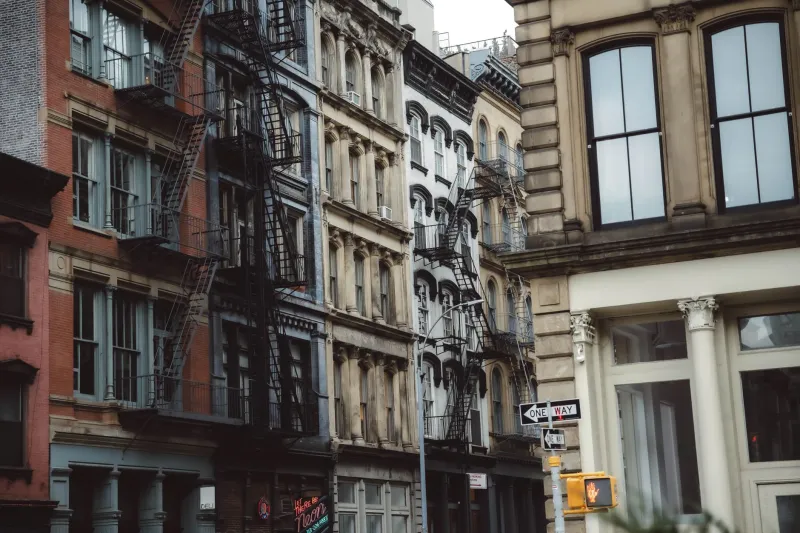
The Upper East Side streets where his salon operated retain much of the patrician elegance that made them a natural home for his clientele. Walking these blocks, one can readily imagine the procession of cultural luminaries — socialites, actresses, musicians — who made their way to Halston's door during the years of his greatest influence.
Studio 54: The Address That Defined an Era
Of all the locations associated with Halston's legend, none carries a more potent cultural charge than Studio 54. Located at 254 West 54th Street in Midtown Manhattan, the nightclub that Steve Rubell and Ian Schrager opened in 1977 became the social and aesthetic epicenter of an era — and Halston was its undisputed presiding spirit.
The building has had many incarnations since its Studio 54 years, and it currently operates as the Studio 54 theater, part of the Roundabout Theatre Company. While the nightclub itself no longer exists in its original form, the physical address retains a remarkable aura for those who approach it with an awareness of its history. The Halston Netflix series devotes considerable attention to Studio 54, rendering its atmosphere with a visual opulence that makes the real-world location feel simultaneously familiar and transformed.
For the visitor, standing outside the building on West 54th Street while contemplating the footage and dramatizations that have captured its legendary years is an experience that collapses the distance between history and the present moment. This is, in its way, exactly what the best cinematic storytelling achieves — and it is what Halston himself, with his instinct for atmosphere and occasion, would have appreciated.
Montauk, New York: Where the Designer Found the Sea
Halston's Montauk compound, located at the eastern tip of Long Island, provided the designer with a retreat from the intensity of Manhattan life and the Studio 54 universe. The property — known as the Halston Compound — was designed in collaboration with architect Paul Rudolph and reflected the same commitment to clean lines and spatial integrity that characterized Halston's fashion work.
Montauk today remains one of the most dramatically beautiful destinations on the East Coast, and the Halston Compound is a recognized landmark of American modernist architecture. While the property is privately held, the surrounding landscape — the dunes, the ocean light, the particular quality of the Atlantic horizon at that latitude — is freely accessible and communicates something essential about the aesthetic sensibility that Halston brought to every domain he inhabited.
The Screen as Map
What the films and documentaries about Halston have accomplished, beyond the preservation of biographical fact, is the transformation of these locations into cinematic coordinates — points on a map that a viewer can follow from the screen into the physical world. For the traveler who has watched Halston on Netflix or engaged with Frédéric Tcheng's documentary portrait, these places are already half-known before the journey begins.
That is the particular gift of fashion cinema at its best: it makes the past visitable. And in the case of Halston, the past is a country worth every mile of the journey.