Cloth as Character: The Material Revolution Halston Brought to the Screen
There is a moment in Ryan Murphy's 2021 Netflix miniseries Halston that stops the frame cold. Ewan McGregor, embodying the designer at the height of his powers, runs his fingers across a bolt of ultrasuede—and the camera lingers. It is not an accident. That gesture, deliberate and almost reverential, encapsulates an entire philosophy: that fabric is not background, but foreground. That what a garment is made of tells us precisely who the person wearing it intends to be.
Halston understood this long before Hollywood did.
The Tactile Obsession That Rewrote American Fashion
Roy Halston Frowick arrived in New York with a milliner's instinct for material. By the time he had shed the hat-making trade and established himself as a womenswear designer of the first order in the early 1970s, his fixation had evolved into something close to a scientific pursuit. He did not select fabrics so much as he interrogated them—holding swatches to natural light, testing their weight against the wrist, observing the way they surrendered to gravity.
His landmark adoption of ultrasuede in 1972 announced a new era. The material, a Japanese synthetic with the supple hand of genuine suede but none of its limitations, was washable, lightweight, and democratic in a way that luxury had rarely permitted itself to be. Halston shaped it into shirtdresses and blazers that moved with the body rather than against it—garments that looked expensive not because they were ornate, but because they were perfectly, almost ruthlessly, considered.
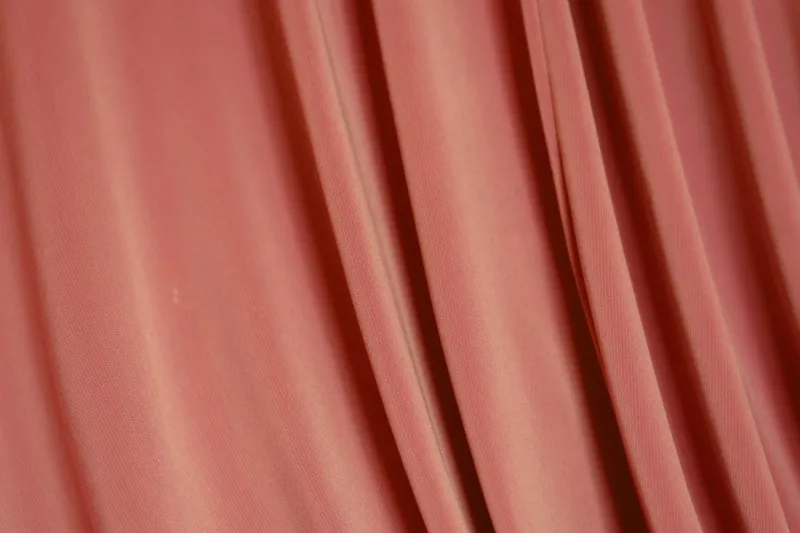
Jersey, too, became one of his primary languages. He draped it across the body in long, uninterrupted falls of fabric, refusing to interrupt the line with unnecessary seaming. Combined with his precise bias-cut construction—a technique that places fabric at a diagonal to the grain, allowing it to stretch and cling in a controlled, sinuous way—his garments achieved a quality that is almost impossible to describe in still photography. They had to move to be fully understood.
This, as it turns out, made them ideal for the camera.
What the Lens Sees That the Eye Alone Cannot
Cinematography is, at its core, the art of capturing movement and light. Halston's fabrics were engineered for exactly those two phenomena. The way ultrasuede absorbed light softly, without the hard reflections of traditional suede or the synthetic sheen of lesser materials, gave it an almost painterly quality on film. Jersey, meanwhile, responded to the slightest shift of the wearer's body—a turned shoulder, a quickened step—with a ripple that the camera could translate into emotional information.
Costume directors working on period productions set in the 1970s and early 1980s have spoken extensively about the particular challenge of rendering Halston accurately on screen. The garments, unlike the heavily structured couture of earlier decades, derived their drama from subtlety. A bias-cut gown photographed under flat lighting reads as almost nothing. But lit from a single oblique source, with the camera positioned to catch the diagonal grain of the cloth, it becomes a study in architectural tension—the fabric pulling gently in one direction, the body asserting itself in another.
In documentary formats, this quality becomes even more pronounced. Archival footage of Halston's runway presentations, incorporated into films such as the 2010 documentary Ultrasuede: In Search of Halston, reveals something that contemporary audiences may find startling: these garments were designed to be seen in motion. The models did not merely walk; the clothes walked with them, each stride releasing a new configuration of drape and shadow.
The Bias Cut as Narrative Device
Filmmakers have increasingly recognized the storytelling potential embedded in Halston's construction techniques. The bias cut, in particular, has become a shorthand for a specific kind of feminine authority—one that does not announce itself through volume or ornamentation, but through the quiet confidence of a perfectly responsive garment.
In scenes depicting powerful women at ease in their own skin, costume directors repeatedly reach for bias-cut silhouettes. The visual logic is sound: a bias-cut dress suggests that its wearer has made peace with her body, that she is not armored against the world but moving fluidly through it. It communicates intimacy and self-possession simultaneously—qualities that are extraordinarily difficult to convey through dialogue alone.
Halston arrived at this construction not through theoretical analysis but through instinct sharpened by relentless practice. He reportedly cut many of his most celebrated garments directly on the dress form, without a paper pattern, trusting his hands to find the line that the fabric wanted to take. That process, improvisational yet deeply disciplined, produced garments with an organic quality that no amount of technical precision in the cutting room could fully replicate.
Ultrasuede and the Democratic Luxury on Screen
One of the more nuanced ways in which Halston's material choices register cinematically is through their relationship to the concept of accessible luxury. Ultrasuede was, by the standards of the era, a relatively affordable material. Yet Halston used it to create garments that carried the visual weight of far more expensive alternatives. On screen, this creates an interesting tension: the clothes read as unquestionably luxurious, yet they do not perform wealth in the obvious, exhausting way that heavily embellished or conspicuously branded garments tend to do.
This restraint is legible to audiences even when they cannot name it. A character dressed in Halston-influenced pieces—smooth, unornamented, fluid—reads as someone who does not need to prove anything. The clothes have already done the proving, quietly, through the quality of their drape.
For filmmakers interested in depicting a particular strain of American ambition—assured rather than anxious, refined rather than ostentatious—this is an invaluable visual tool. It is no coincidence that costume directors working on narratives set in the worlds of media, publishing, and the arts so frequently return to Halston's material vocabulary. The fabrics carry associations that have only deepened with time.
A Legacy Written in Drape and Light
Halston's contribution to the screen is not confined to the garments that appear in films about him, though those are considerable. His deeper influence lies in the visual vocabulary he established—a set of material principles that have permeated costume design, editorial photography, and fashion filmmaking in ways that are sometimes difficult to trace precisely because they have become so thoroughly absorbed.
The camera loves what Halston loved: movement, simplicity, the drama of fabric meeting light. In that alignment between the designer's obsessions and the medium's capabilities, something enduring was created. Every time a cinematographer lingers on the fall of a bias-cut hem, every time a costume director selects a fluid jersey over a stiffer alternative, Halston's influence is at work—quiet, authoritative, and as precisely placed as a perfectly cut seam.